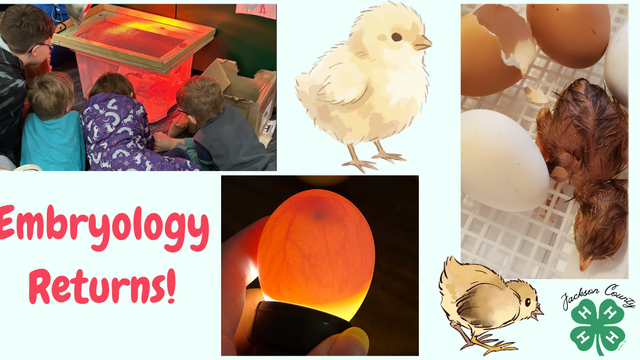
A weird headline, right? Well, I like to keep things interesting, and it makes sense for the news I have to share (I promise!). April is a wonderful month; spring is in full swing, and 4-H begins our annual Embryology journey. That’s right, 2nd graders across the county will be learning about chickens, amniote development, and local food systems.
This is my favorite time of year, and it really is because of the chicks! Long time readers might recall I worked with livestock for a while between my Bachelor and Master degrees. One of the animals I worked with were chickens. I worked with an amazing team to incubate, hatch, raise, and care for hundreds of chickens every year. Ever since I started this job just over a year ago, it has been my goal to have embryology in every school in Jackson County. Now, I’m not there yet, but 4-H and our incubators will be spotted in 6 schools across the county this April and May, and I’m jazzed about it! Can you tell?
This spring, students will get the chance to read, write, craft, and experience science. This kind of learning makes them not only better scientists, but better communicators, better creators, and lets students see themselves in a STEM or agricultural job in the future (1, 2, 3). I bet you weren’t expecting that, were you! That science actually makes you a better linguist.
Teachers are really the heavy hitters here (despite my witty article). Teacher interaction is the key for this (1, 2), and all the teachers participating this year are ready, set, and eager to begin. This partnership with their dedicated instruction means that they are able to keep students engaged and with more time and activities than I could provide in my visits.
Not only is this a personal passion of mine, but the experiential (hands-on) learning model of 4-H and the curriculum utilized by staff and teachers during this program have so many wonderful impacts on students now and in the future (1). In 4-H we want to make the best better, and prepare every young person to be a successful and well rounded grown-up. Obviously, every child cannot receive every benefit, but we’re optimists here, and the benefits of having hands-on, integrated STEM education in classrooms are astounding, far reaching, and I cannot wait to get back to it.