Information on Tree Care
Tree Care Tips
When Was Your Tree Cut?: Freshness, Fire Safety, and Your Tree
Christmas Trees at Home
Post-Harvest Pests on Christmas Trees
Old Christmas Trees Can Benefit Wildlife — US Fish & Wildlife Service
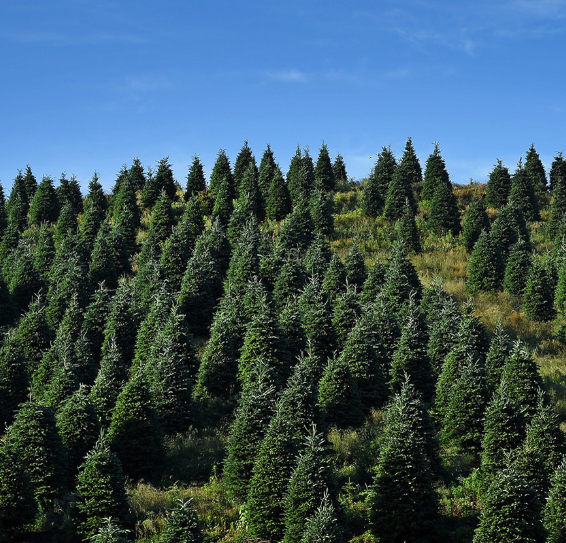
thousands of trees.
Many publications have been written concerning postharvest physiology, handling, and keepability of Christmas trees. Despite this, there is often ignorance of the subject, resulting in wasted trees, reduced tree quality, erroneous information, or dissatisfied consumers.
An updated version of Agricultural Handbook 66 was published by the U.S. Department of Agriculture in 2016 which reviewed postharvest handling practices for more than 140 agricultural crops. One chapter summarizes postharvest research for Christmas trees, including keepability ratings for about 35 conifer species.
Most of the Christmas trees grown in NC are Fraser Firs. These have an Excellent (E) rating with potential to last 4-6 wk under typical household conditions.When supplied with water, cut Christmas trees generally consume about 1 qt of water per day per inch of stem diameter. Thus, a tree with a 4-in diameter trunk would use about
4 qt of water per day. The biggest mistake by consumers is using a stand with too
little capacity, resulting in trees drying up between waterings. If this happens, the tree might not rehydrate when rewatered. Water use changes during the display period and also varies among species. Compared to other species, true firs tend to use large quantities of water over extended display periods. For example, a 6-ft Fraser fir can easily use 4 qt of water per day during the first 5 to 7 days and 2 to 3 qt per day thereafter for the next 3 to 4 weeks.
Many chemicals and home concoctions have been tested in hopes of prolonging the life of cut Christmas trees. Additives are of little benefit and sometimes produce adverse effects. Additives can undesirably increase water consumption by
displayed trees. Because people often use stands that are too small, increased water consumption would increase the likelihood of a tree “going dry” in the stand. Some additives can induce heavy needle loss. The best tree preservative is plain
water, without additives.
The Christmas tree chapter can be accessed on-line by going to the following link and then scrolling to page 650 (page 660 in the pdf):
The full reference is as follows: Hinesley, L. E. and G. A. Chastagner. 2016. Christmas tree keepability. p. 650-658. In: Gross, Kenneth C., Chien Yi Wang, and Mikal Saltveit (eds.). The Commercial Storage of Fruits, Vegetables, and Florist and Nursery Crops. Agriculture Handbook 66, revised. USDA, Agricultural Research Service, Beltsville Area.
Enter your email address to receive updates.